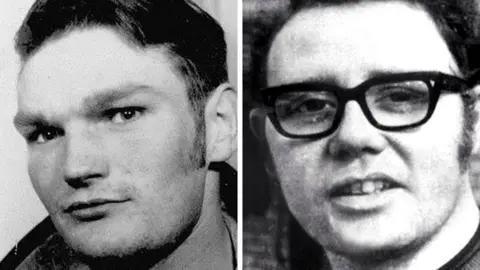

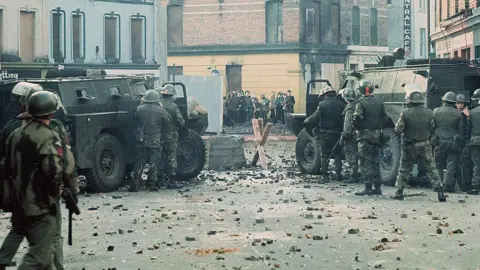
January 30th, 1972 stands as arguably the most fatal – and momentous – occasions during thirty years of conflict in the region.
Within the community where events unfolded – the legacy of Bloody Sunday are painted on the buildings and embedded in public consciousness.
A protest demonstration was conducted on a cold but bright day in Londonderry.
The protest was opposing the system of internment – detaining individuals without legal proceedings – which had been implemented following three years of unrest.
Troops from the specialized division killed thirteen individuals in the district – which was, and continues to be, a predominantly Irish nationalist area.
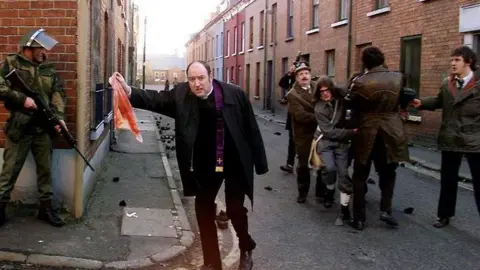
A particular photograph became particularly iconic.
Pictures showed a clergyman, Father Daly, displaying a blood-stained fabric while attempting to defend a crowd carrying a youth, the fatally wounded individual, who had been killed.
News camera operators captured considerable film on the day.
The archive contains the priest telling a reporter that military personnel "gave the impression they would fire in all directions" and he was "absolutely certain" that there was no provocation for the shooting.
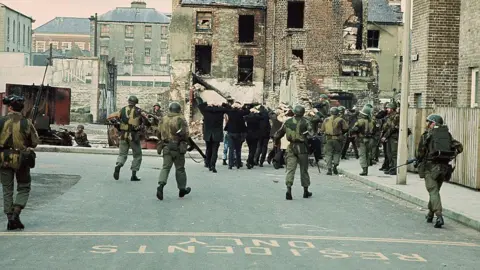
This account of the incident was rejected by the original examination.
The Widgery Tribunal determined the Army had been fired upon initially.
Throughout the resolution efforts, Tony Blair's government commissioned a new investigation, after campaigning by bereaved relatives, who said Widgery had been a whitewash.
During 2010, the findings by Lord Saville said that on balance, the paratroopers had initiated shooting and that none of the victims had been armed.
The contemporary head of state, the Prime Minister, expressed regret in the Parliament – saying fatalities were "unjustified and unacceptable."
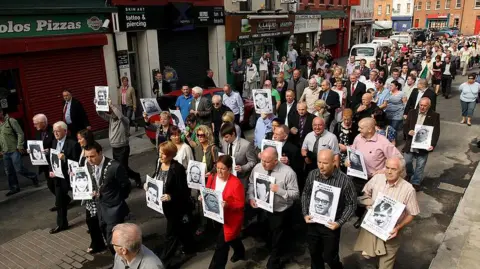
Law enforcement commenced examine the incident.
One former paratrooper, referred to as the accused, was prosecuted for murder.
Accusations were made regarding the killings of one victim, 22, and twenty-six-year-old another victim.
Soldier F was additionally charged of seeking to harm several people, other civilians, more people, another person, and an unidentified individual.
There is a court ruling preserving the veteran's identity protection, which his lawyers have maintained is required because he is at threat.
He stated to the investigation that he had only fired at individuals who were carrying weapons.
The statement was dismissed in the concluding document.
Evidence from the investigation could not be used straightforwardly as proof in the criminal process.
In court, the accused was shielded from sight using a blue curtain.
He spoke for the first time in the proceedings at a hearing in late 2024, to respond "not guilty" when the allegations were read.
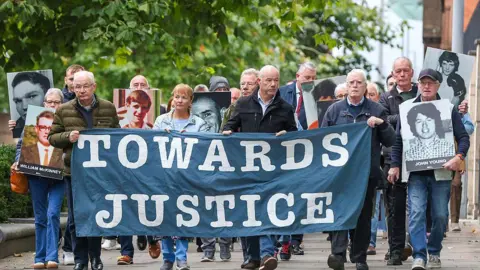
Kin of the deceased on that day travelled from Derry to the courthouse daily of the trial.
One relative, whose brother Michael was fatally wounded, said they understood that attending the proceedings would be difficult.
"I can see the events in my memory," the relative said, as we visited the primary sites discussed in the case – from the street, where the victim was killed, to the adjoining the courtyard, where one victim and William McKinney were killed.
"It reminds me to my position that day.
"I participated in moving Michael and put him in the ambulance.
"I experienced again each detail during the testimony.
"But even with experiencing all that – it's still meaningful for me."